
What Tools Do I Really Need for Interior Painting in Tampa, FL?
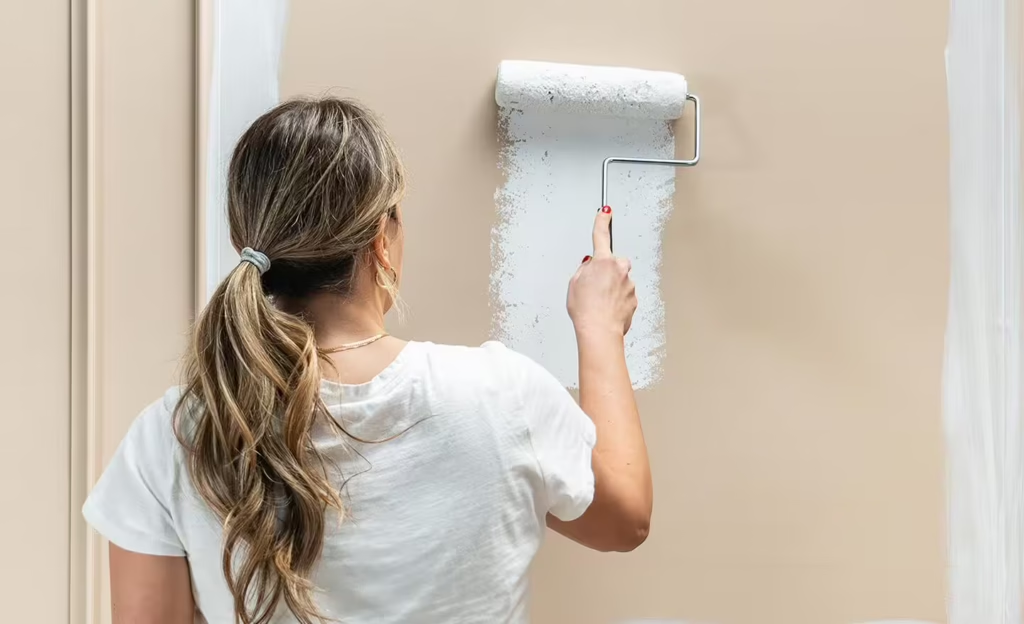
- A Seminole Heights bedroom repaint turned into a four-day fight with humidity, chalky walls, and shellac stains.
- The tools that mattered most were the ones nobody puts on a Saturday-morning shopping list: a hygrometer, a brush comb, a paint grid, and a small can of shellac primer.
- Sheen, nap, and timing matter more in Tampa than the brand on the can.
- Borrow the long roller and the platform ladder. Buy the angled brush and the primer.
- If the wall keeps flashing through two coats, the problem is not the paint.
The situations described here are composites drawn from the types of jobs and decisions we encounter regularly. Names and specific figures are illustrative.
The call came on a Tuesday morning in August, and we already knew what it was going to be before the homeowner finished the second sentence. She had spent the weekend painting her son’s bedroom in Seminole Heights, the second coat had gone on Sunday afternoon, and by Monday morning the wall had what she described as “a kind of cloudy patchwork, almost like the paint was sweating.” She had used a paint-and-primer in one, a $14 roller kit from the hardware store, and the can said “dries in two hours.” It had been a long weekend.
What she was really asking, underneath the question about the cloudy wall, was the question almost every first-time painter in Tampa ends up asking eventually: what tools do I actually need to do interior painting in Tampa, FL the right way, and which of the things on the hardware store endcap are just there to take my money? We told her we’d come by that afternoon, look at the wall, and walk her through what we keep in the truck for a job like hers. The story that followed is the one we end up telling a lot of homeowners, so it’s worth telling here in full.
Where the call usually starts
The bedroom was a back bedroom in a 1956 block house, plaster over masonry on the exterior walls, drywall on the two interior partitions. The previous owners had repainted at some point in the early 2010s — flat builder white over what looked like an older eggshell. The new color was a soft, warm gray she had picked from a sample card on a sunny afternoon, which is the lighting condition under which every gray on earth looks correct and approximately none of them actually are.
She had done the things the YouTube videos told her to do. She moved the furniture. She taped the trim. She rolled in a W pattern. She used what the can called a “premium” roller cover. What the videos hadn’t told her was that her air conditioning was set to 78 to save money during the day, that the windows had been open while she cut in to “air the room out,” and that the relative humidity inside the house at the moment she started rolling was somewhere north of 70 percent. Latex paint at 70 percent humidity does not behave the way latex paint behaves in a Phoenix garage at 30 percent humidity, which is the humidity the can assumes you have. The cloudiness was the second coat going on while the first coat had not finished releasing water vapor. The paint had nowhere to send the moisture, so it held it, and it dried with a kind of hazy bloom across the surface.
What we pulled out of the truck first
Before we touched a brush, we pulled out a $12 hygrometer and set it on the dresser. It read 68 percent inside the room. We turned the thermostat down to 73, closed every window, and asked her to give the house an hour. While we waited, we opened the closet, scraped a quarter-sized chip of the old paint off an inside corner with a putty knife, and held it up. The back of the chip was chalky. The wall, under the chalk, was sound. The two layers above it were not bonded the way they were supposed to be, which meant the new paint was sitting on a foundation that was already a little loose.
None of that was a disaster. It just meant the tool list she had assembled — roller, tray, tape, two-and-a-half-inch angled brush, drop cloth — was missing about half of what the job actually needed. The half it was missing was the half that nobody buys on the first trip to the store, because nobody tells you it matters until the wall is already cloudy.
The tools nobody puts on the shopping list
Here, in the order we use them, is what we ended up unloading onto her dropcloth. These are not the headline tools. They are the ones that decide whether the headline tools work.
- A hygrometer. The same $12 gadget that told us her room was at 68 percent. If indoor relative humidity is above about 55 percent, latex paint dries slowly enough that a second coat applied “two hours later” will trap moisture. In Tampa in summer, with the AC set conservatively, almost every house we walk into is above 55 percent.
- A small can of shellac-based spot primer. Not a gallon. A quart. It costs around $20 and it is the only thing that reliably blocks the kind of stains we see in older Tampa houses — water marks near the ceiling line, mildew shadows in bathrooms, the ghost of a smoker, the brown halo around a roof leak that someone patched ten years ago but never primed over. Latex primer will not lock those in. The stain will come back through two finish coats and look like a personal insult.
- A brush comb. A $6 piece of metal with two rows of teeth. It pulls dried paint out of the heel of a brush, which is where brushes actually die. A good two-and-a-half-inch angled sash brush costs $18 to $25. With a brush comb and a habit of cleaning it properly, it will last you ten rooms. Without one, it will last you two.
- A paint grid and a five-gallon bucket. Forget the tray. A grid hooks over the rim of a bucket. You load the roller against the grid, roll the excess off, and the paint stays in the bucket where it cannot dry out, cannot tip over onto the floor, and cannot skin over while you stop to answer the door. On a humid day, a tray of paint will start to skin in twenty minutes. A bucket with a lid will hold for the entire job.
- A real canvas drop cloth, not plastic. Plastic is slippery on tile and terrazzo, which is what half of Tampa’s older houses have. It also pools any drip you make and turns it into a puddle that gets tracked. Canvas absorbs, stays put, and folds up at the end. A 9-by-12 canvas drop costs about $25 and lasts for years.
- An extension pole. Not for the ceiling, although it helps there too. For the walls. A four-foot pole on a nine-inch roller frame gives you a steadier stroke than your arm does, evens out the pressure across the roller, and keeps you from leaning into the wall and printing the cover pattern into the finish. It also keeps you off the ladder for everything below the crown molding, which matters more than people think after three hours of cutting in.
None of those are exotic. None of them are expensive. Together they cost less than a single gallon of premium paint. They are the difference between a finish that looks like a painter did it and a finish that looks like a Saturday did it.
The tools we told her to buy and the ones we told her to borrow
This is the question we get more than any other, and it deserves a clear answer. There are tools you should own if you intend to paint more than one room in your life, and there are tools you should borrow from your brother-in-law or rent from the hardware store and return in the morning.
Buy the brush. A good angled sash brush is personal. It breaks in to your hand, your wrist, your cutting style. Borrowing one is like borrowing someone’s running shoes. Buy the roller frame, because cheap frames flex and chatter on textured walls and the difference is visible in raking light. Buy the brush comb and the shellac primer and the hygrometer, because they’re cheap and they pay for themselves on the first job.
Borrow or rent the eighteen-inch roller for big rooms, the dehumidifier if you only need it once a summer, and the multi-position work platform for stairwells and vaulted ceilings. Those are tools you use rarely and store always, and storage in a Tampa garage is its own problem.
What we did to her bedroom wall
By the time the room got down to 54 percent humidity, the cloudy patches on her wall had actually softened a little — some of the trapped moisture had released once the air around it could accept it. We let it sit overnight with the AC at 73 and a small box fan moving air across the wall, not at it. The next morning the cloudiness was mostly gone, but the surface was still uneven where the second coat had laid on while the first was wet.
We sanded the whole wall lightly with a 220-grit sponge — not to remove the paint, just to knock down the lifted bits and give the next coat something to grab. We spot-primed two small stains near the closet door with the shellac, because we’d seen the chalky chip and we did not trust the previous repaint to stay where it was. Then we cut in fresh, rolled one full coat from a paint grid in a bucket, waited the better part of a day, and rolled a second. The finish was even, the color was the warm gray she had picked, and she texted us a picture of the finished room the next weekend.
The thing she said on that text was the thing most homeowners say after a job like this: “I can’t believe how much of it was the prep.” That is the lesson, and it’s the one no shopping list ever teaches you.
What homeowners usually ask at this point
Most homeowners ask us a version of the same five questions when we walk them through a repaint. We answered three of them sitting on her dropcloth that morning, and the other two came up by text over the next week. They’re worth laying out the way we actually answered them, because they come up on almost every job.
The first one is always about primer. Do I really need it if the can already says “paint and primer in one.” On a clean, sound, recently painted wall, no, you probably don’t. On a Tampa wall with chalk, stain history, or a coat of glossy enamel underneath, yes, you do. The all-in-one cans are paint with extra binders. They are not stain blockers. Shellac primer is.
The second is about roller nap. Three-eighths or half-inch. The answer is: three-eighths for smooth walls and satin or eggshell finishes, half-inch for textured walls or flat ceilings. If you see skip marks on the peaks of orange peel, the nap is too short. If the finish looks like orange peel itself even on a smooth wall, the nap is too long.
The third is about timing between coats. The can says two hours. In Tampa in August, two hours is optimistic. We wait four to six on walls and a full overnight on trim. The clock is not the test. A clean fingernail dragged across a hidden corner is the test. If it leaves a mark, the coat is not ready.
The fourth question is about tape. Can I leave it on overnight. You can, but in Tampa humidity the adhesive bonds harder by morning and you’ll lift fresh paint with it. We pull tape at a forty-five-degree angle while the paint is still slightly soft, usually within an hour of finishing the coat.
The fifth question is the one we get when something has already gone wrong, and it’s the one we got from her at the very beginning: when do I stop and call someone. The honest answer is: when the wall keeps telling you the same thing two coats in a row. If you have flashed, if you have peeled, if a stain has come back through two coats of finish, the paint is not the problem and the next gallon will not fix it. That’s the point where the cost of more paint exceeds the cost of an hour of someone else’s diagnosis.
Where DIY stops making financial sense
We are not trying to talk anyone out of painting their own bedroom. Most rooms in most Tampa houses are completely reasonable DIY projects, and the result of a careful weekend with the right tools is usually indistinguishable from professional work. But there are jobs where the math stops working in the homeowner’s favor, and it’s worth naming them.
Vaulted ceilings and stairwells are the obvious ones — the access alone justifies the cost of a pro, and the safety equation gets worse with every additional foot of ladder. Textured ceilings where they meet the walls are another, because cutting a clean line without pulling texture is a skill that takes years and a specific brush technique. Houses with a long history of moisture intrusion are the third — when the stain comes back through the shellac, the problem is in the envelope, not the finish, and painting over it is just buying time. And anywhere a previous coat is peeling in sheets, the labor of stripping and bonding exceeds the labor of just painting from scratch.
If the project is starting to sprawl past a single weekend, it’s worth getting a written estimate before you commit any more cash to materials. We’ve written about what changes when the project is bathroom cabinets, which involves a different set of primers and a much longer cure window than wall paint, and the same general logic — prep is most of the job — applies even more there.
What the right tools actually buy you
A clean finish in a Tampa room is not the product of an expensive can of paint. It’s the product of controlling the air, respecting the surface underneath, and using a small handful of tools that almost nobody puts on the first shopping list. A hygrometer, a quart of shellac primer, a brush comb, a bucket with a grid, a canvas drop cloth, and an extension pole will carry you through almost any room in almost any house in this city. The brush and the roller frame are the ones you spend real money on. The paint, within reason, is mostly the paint.
What good tools really buy you is not a better finish on the day you paint. It’s the ability to see what the wall is actually doing while you paint it — to notice the chalk, to feel the tape lifting, to catch the cloudiness before the second coat traps it — and to respond before the small problem becomes the big one. That is the part of the job that nobody can sell you in a kit, and it’s the part that decides how the room looks a year from now under a different angle of light.
If you’ve started a room and the wall keeps telling you something is wrong, or if you’re looking at a vaulted ceiling and reconsidering your life choices, you can reach our Tampa handyman team through the contact page. For homeowners thinking through whether to take on the larger painting project themselves, the work that goes into interior painting in Tampa, FL is mostly the work of preparation, climate, and patience — and a fair amount of it can be learned one room at a time.
